The Survival Weekly Dispatch - Volume 13, Issue 13

Hey folks, thanks for checking out the newsletter this week. I feel like I’ve gotten more actual work done in the last two days than I did all of last week. Still not where I want to be in terms of the completed deadlines list, but I’m getting there.
The whole Bark River Knives debacle took up entirely too much of my time, energy, and bandwidth last week. For those curious, here’s a short, relatively impartial write-up I did for Tactical Knives. I caught no small amount of grief due to that impartiality, too. With that in mind, let me be very clear about my take on this fiasco.
The con job(s) Mike Stewart pulled are abhorrent and inexcusable. I’m told multiple law enforcement agencies are involved at this point, and I sincerely hope every guilty party is sentenced to the maximum penalties allowed by law.
This is the statement I posted to Facebook last week.
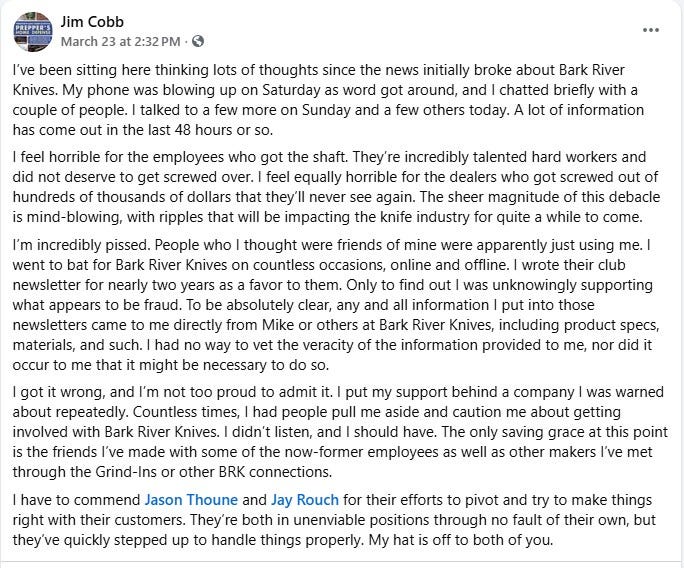
At this point, I’ve largely washed my hands of the whole mess and I’m trying to move on.
* * *
Today is April Fool’s Day. Personally, I’m not a fan as all it does is bring out Amateur Hour nonsense as well as people being jerks but calling it a joke. It is one of those “holidays” that makes me really glad I work from home. In any event, over the next couple of days think twice before sharing outrageous news stories as even more nonsense than normal will be floating around.
* * *
This is a short excerpt from my upcoming book, Common Sense Everyday Carry.
Originating in the Middle East, the shemagh is sort of a bandana on steroids. Like the bandana, it’s a square piece of cotton fabric, but it typically measures 42 inches on a side, or 1,764 square inches. It’s more scarf than it is handkerchief.
Shemaghs are available from several companies, and they come in a wide range of colors and patterns. Sometimes you’ll hear the shemagh referred to as a keffiyeh, but while they’re similar in appearance, these are two different things. The shemagh is sort of a generic head scarf where the keffiyeh is a specific head garment worn by Palestinians. The keffiyeh has significant cultural significance. It is traditionally black and white, with intricate symbols woven into the fabric.
I’ve had some people point out that the traditionally printed shemagh might be problematic in some areas, because they might appear to be symbolic of one or another Middle Eastern country. I don’t know if that’s truly a valid concern or not, but it’s worth considering, I suppose.
From an EDC standpoint, most of the uses of a shemagh are more wilderness than urban or suburban. But they’re still worth noting. The first and most basic use of a shemagh is head protection. It can be worn in several different ways to protect your head and face from the sun, wind, and dirt or sand.
In hot weather, you can soak it in water, then drape it across your neck and shoulders for a cooling effect. When it gets cold out, you can use it as an insulating scarf. The shemagh is large enough to serve as a small, thin blanket if you’re napping. Fold it up and it can work as a bit of a cushion when sitting on bleachers or another hard surface. It isn’t ideal, but it helps. Similarly, you can fold it smaller and use it as a makeshift pillow. I’ve done this a couple of times on long flights. It’s far from ideal but works. If someone is injured, the shemagh can be tied as a bandage or used as a cravat to cradle an arm.
Out in the field, you can use one as a hot pad or oven mitt of sorts, protecting your hand as you grab pots from the fire. It can also be used as a hobo bindle. This is where you’d lay the shemagh flat, place your belongings in the middle, then pull up the corners and tie them together. Thread that onto a stick and you’re ready to ride the rails.
* * *
Here are a few of my more recent submission to GAT Daily. All are free to read.
Hidden Messages – Using Code Words with Family Members
Water Purification – How Long to Boil Water?
Antibiotics – Should the Prepper Stockpile Them?
* * *
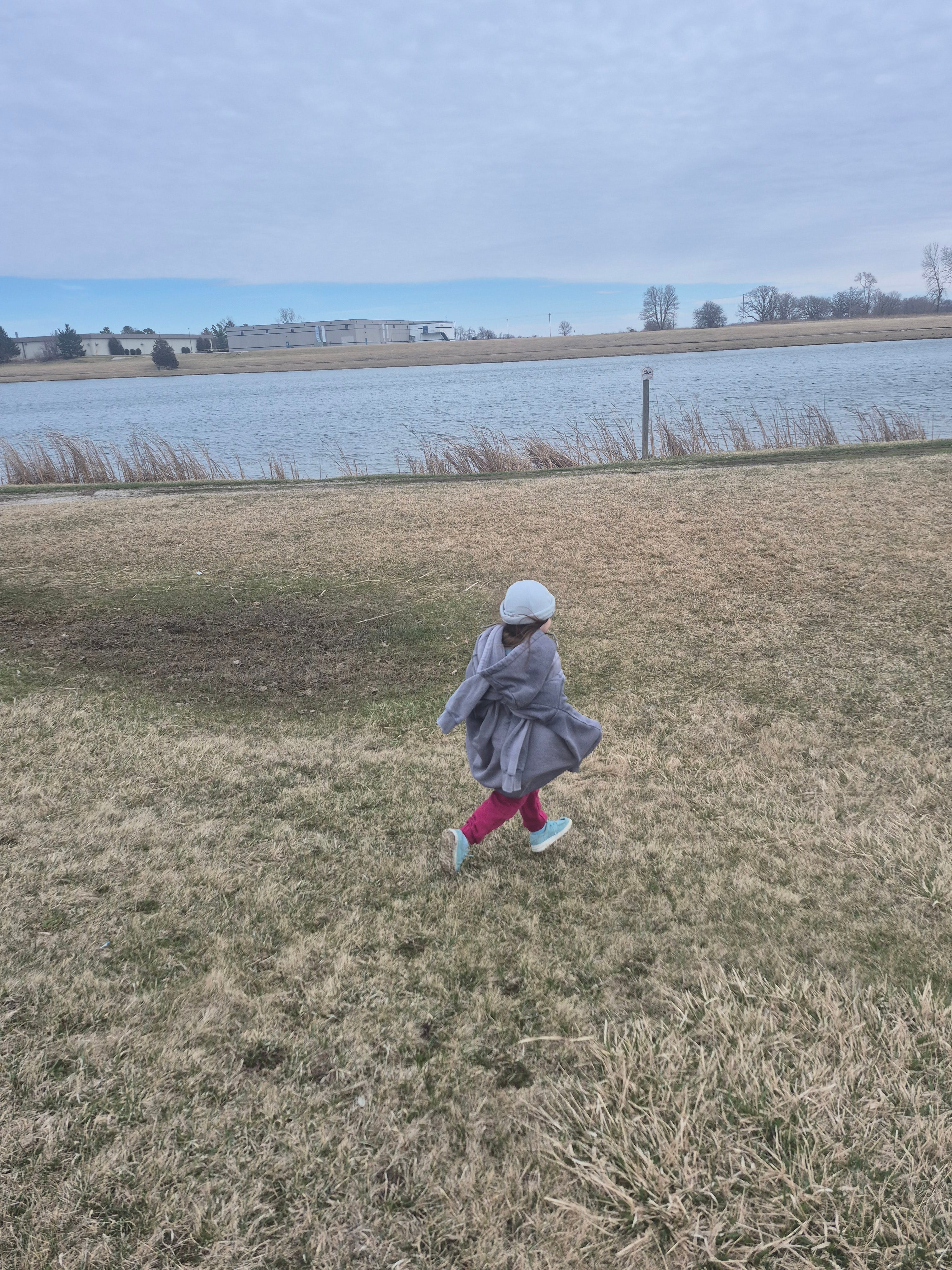
We had our granddaughter over the weekend, and it was windy and chilly, so we did a short walk around the pond at Babe Mann Park in Elkhorn, Wisconsin. She was really cold when we started out, so we wrapped one of my hoodies around her over her coat. She warmed up once we got moving and took it off, but she looked pretty adorable.
Survival Tip — Bicycles for Disasters
Spring and Summer are ripe for rummage sales. If you don’t already own one, you might consider grabbing a bicycle on the cheap. They can be quite handy for transport if the grid goes down and refilling your car at the gas station isn’t feasible. Even an older bike can be given new life with just a few tweaks like new innertubes and brake adjustments. If you don’t know how to do the work, YouTube can help.
Even if it has been several years since you last rode one, the saying is true. It’ll come back to you fairly quick.
The thing is, though, a bike doesn’t need to be ridden to be useful. As countless people have discovered, you can load the bike up with bags and such filled with supplies, then push it along rather than riding it.
Just some food for thought for those who like to go rummaging on the weekends.
Backwoods Survival Guide Magazine
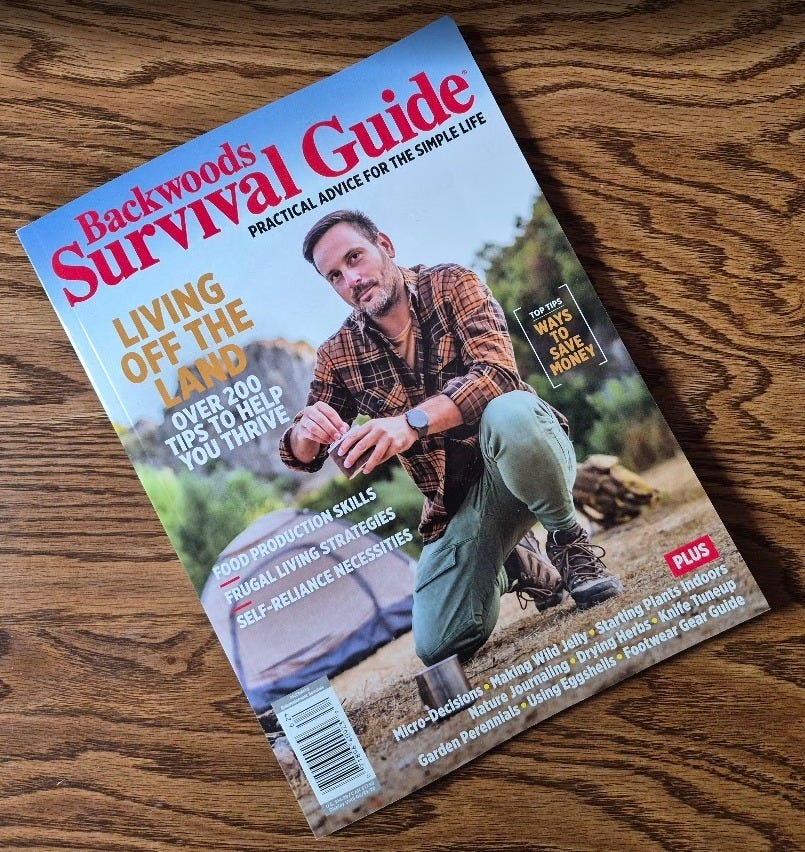
For those new to my little corner of the Internet, I am the Editor in Chief for Backwoods Survival Guide magazine. Here is the cover for the current issue available in stores right now.
You can find Backwoods Survival Guide just about anywhere magazines are sold, including:
Walmart
Publix
Walgreens
Rite Aid
CVS
Tractor Supply
Fleet Farm
Barnes & Noble
Questions, Comments, Complaints, Concerns?
I am always just an email away - jim@survivalweekly.com.
One night a while back, instead of sleeping I woke up thinking about transportation in these troubled times. I remember back around 1974 when OPEC had cut us off. If I remember right we could buy gas every other day and it was limited to 10 gallons. During that time I lived two blocks from a Safeway store and I could walk 3/4 mile to work. I am now in my 80's and I live 5 miles from a grocery store. I have an old bicycle but the roads here a narrow and there are a lot of people who drive like they don't believe bicycles have a right to be on the road. I quit riding because of the danger it represented. I have a power outlet in my garage that my son put in to recharge his EV when he came to see us. The NW has very little power produced by petroleum products. An EV would be a good survival investment, so I went shopping.